|
|
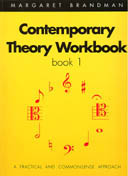 Contemporary
Theory Workbook - Book 1 Contemporary
Theory Workbook - Book 1
The
Contemporary Theory Workbooks are recommended reference material
for the AMEB's Contemporary Popular Syllabus. They also provide support and training for the Music Craft syllabus requirements.
Click on the images below for an
enlarged version
Thanks for the recommendation of your Contemporary Theory Books 1 & 2 for my student
for Grade 2 Music Craft. He was struggling with the AMEB Music Craft books but your books opened the way for him. He got 93 for the exam which I think is OK for doing it all on his own.
Chris Collins - Sydney Teacher -Oct 2008
I'm still using your Contemporary Theory Books for my PianoExpress courses for adults. They're proving a great success because they're more like reference books helping to reinforce theoretical points we cover from the music. Each page looks at one point, gives a simple explanation and a few exercises.
That's what adults want!
Helen Kennedy, Sydney Music Enterprises Nov 2008
PART A
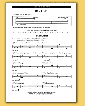 |
INTERVALS:
Prime, 2nd, 3rd, 4th and 5th |
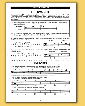 |
CLEFS:
Note naming in Treble, Bass and C Clef (Alto and Tenor Clefs)
|
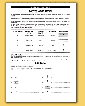 |
BASIC
NOTATIONAL ELEMENTS:
Staff, Bar Lines, Leger Lines, Accidentals etc.
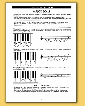
TIME
ELEMENTS:
Note Values and their matching rests.
Dotted Notes and their matching rests.
Time Signatures |
 |
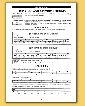
SCALE
CONSTRUCTION:
Tone and Semitones; the Major Scale Pattern; Key Signature.
|
 |
PART
B
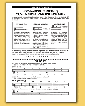
INTERVALS:
6th, 7th and 8th; Harmonic and Melodic Intervals
|
 |
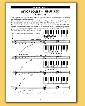
CLEFS:
Treble, Bass and C Clef (Soprano, Mezzo-Soprano and Baritone
Clefs) |
 |
TIME
ELEMENTS:
16th notes and rests, Simple Time
SCALE
CONSTRUCTION:
All Major Scales; Key Signature Patterns; Cycle of Fifths;
Chromatic Scales
|
 |
CHORD
CONSTRUCTION:
Major and Minor 3rds; Major, Minor, Diminished Augmented
and Suspended 4th
Triads in Root Position and Inversions |
| |
GENERAL:
Degree Numbers and Names; Musical Terms, Signs and Symbols;
Repeat Signs.
|
|
| |
COLOUR CODING FOR REMEMBERING THE SIGNPOST NOTES
This colour coding system enhances memorisation of each of the C's .
Use this system on Pages 13-18 of Contemporary Theory Workbook, Book 1
Colour coding for the signpost C's.
Highlight colours are as follows:
TREBLE CLEF
- Very High C - light pink representing a very high female voice in the soprano singing range
- High C - pink - representing a high female voice in the soprano singing range
- Middle C - continue to use red, representing a low female voice in the alto singing range
BASS CLEF- Middle C - continue to use light blue representing a high male voice in the tenor range
- Low C - dark blue representing a low male voice in the bass singing range
- Very Low C - darker blue representing a very low male voice in the bass singing range.
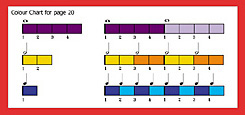
This
is the colour chart for the 'Rhythm
Training Boxes' that students colour in. |
Books
One and Two
A practical and commonsense approach to music theory covering
all the basics right through to the modes and higher grade
information.
The
page per lesson format encourages the student to move forward
at a page a week pace or faster. (Answers included)
'Each
subject is covered in such a way as to flood the student's
mind with light. Sprinkled throughout are topics never covered
except in encyclopaedias, refreshingly and clearly explained
in easily understood statements displaying breadth and clarity.
They are simply a must for every student and teacher's library.'
-Neville
Thomas O.A.M., Former Lecturer in Woodwind Studies, Sydney Conservatorium
of Music
|
|