|
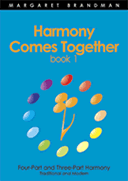 Harmony
Comes Together Harmony
Comes Together
book 1
Harmony
Comes Together is designed to equip the student
with the necessary skills to write both four-part and three-part
classical harmony and to cross the divide between contemporary
popular, jazz and contemporary classical writing styles
with ease and understanding, all the while giving experience
in skills required for both classical and contemporary examination
syllabi. This harmony method is the part of an integrated
course which provides materials for ear-training (audio
and workbooks), theory, improvisation, technique and repertoire.
Margaret
Your book really has the WOW factor! You explain absolutely
everything, methodically and meticulously. The explanation
of the different terms and labels used by both the British
and American systems will be most appreciated, given the
introduction of the new AMEB Music Craft syllabus. Abe
Cytrynowski
The
presentation is superb from cover to cover, the layout clear,
concise and extremely user-friendly – I especially
like your colour coding and combination of traditional and
modern methods. It’s enough to make me want to teach
traditional harmony again!! Kerin
Bailey
More
great reviews from Music Teachers Assocations and Examination
Bodies
Clicking
on the image below will open a larger version
Key
features of this book are:
 |
- the
emphasis on the understanding of the cycle
of fifths
and chord tables
|
 |
- gestalt
approach
— using the gestalt (whole) view of the topic
of harmony, students are equipped to see, hear and
understand the chords in context
|
 |
- the
understanding of root progressions
which:
a) helps the student of harmony make connections
between various progressions and the movement of
the parts
b) imparts the knowledge of the effect of the progressions:
static, weak or strong
|
 |
- the
use of colour coding and graphics
to impart concepts and illustrate ideas
|
 |
- the
use of various types of labelling from both the
British System and the American system, so that
information in this book can be used with multiple
examination syllabi
|
 |
- the
use of both traditional system of figuring
for chords and modern chord symbols
to make the link between old and new systems
of music notation and harmonic understanding.
|
 |
- the
awareness of sounds in both classical
and popular music
|
 |
- encouragement
for the student to play and listen to
the progressions and to interpret them with modern
rhythms
|
You
can purchase a copy of this book by clicking here
|